How I Bat 50 Percent at Getting HARO Links (with their free account)

One well-known method of getting links is through the HARO platform that connects reporters with expert news sources. If you are an expert in any particular industry you can greatly benefit from HARO (short for Help a Reporter Out) if you are featured in their stories, some of which are on major media outlets like The NY Times, Huffington Post and Entreprenuer.com.
As you are probably already aware, getting featured on huge media publications does wonders for your exposure but the reference to your website in link form is also a huge win in terms of SEO.
Today I’m going to talk about how I’ve successfully managed to bat at about 50 percent in terms of getting links from HARO reporters. In other words, I have figured out a nice little method that sees that for about half the time I respond to stories I do in fact earn the media exposure and that thing I’m really after, a backlink from a high PageRank site.
And guess what? I’m going to share all of my tips and secrets with you today so you can do the same thing for your website.
Getting Started with HARO
This post is not going to be about how to setup an account with HARO – any monkey with an internet connection knows how to do that. I am talking about how I bat 50 percent with a free account as HARO does offer premium accounts that start at $19 a month.
I’ve never actually tried a premium account but the major differences are that you get to build a profile on the HARO website in which reporters can find you and you get to search their database anytime rather than wait for one of the three-a-day emails they send out with a free account.
I’ve got nothing against the premium accounts and in fact I think they would be a great value for someone who wants to dedicate a lot of time to getting featured. But I’ve had some good success with the free platform (and I pay for plenty of other SEO-type software) so this post is all about free!
Should you want to learn a bit more about the premium accounts and using HARO that way, Quicksprout University has a nice little video by Brian Dean that covers some of the ins and outs of using the platform from his perspective.
In case you’re wondering if HARO links are on the radar of Google’s Penguin algorithm the same way they are for gamey press release or low quality links, here’s a post by Search Engine Land titled “Actually, we don’t think Google Hates HARO links” that should rest that case for you.
So, now that we have gone through the assumption that you have done the following:
- Setup a HARO account
- Setup your preferences based on your (or your clients) expertise
- Are getting HARO emails
We can move on to my secrets for getting more links from HARO.
Tip #1: Open HARO Emails Quickly to be the First to Respond
If you are truly on the prowl to get media exposure and links from HARO reporters you have to be diligent about the process.
This means anticipating that each email you get from HARO will present a link building opportunity for you should you capitalize on it. That said, once you get your HARO email, open it quickly and peruse the topics to see if there are any that stand out.
What I would not recommend is flagging the email and getting back to it later. Timeliness is something that is very important to reporters. Keep in mind that they are pressed for time and want to get their story compiled and sent over to their editors as quickly as possible.
Without mentioning the obvious component of every story, the deadline, just because a reporter says their deadline is in three days doesn’t mean you can take your time and submit your story in two days. You’ll be doing so after they have already received dozens, if not 100s, of other submissions that might be worthwhile.
Like this tip? Click here to tweet it!
Tip #2: Drop Everything and Respond Right Away
Continuing on the timeliness factor, once you have decided that a topic that comes across the HARO email is appealing it is time for you to stop everything you are doing and get to responding.
Even if you are the most qualified person who responds and provides the most detailed, well-written response, if you respond late there’s a good chance your email won’t even be looked at because the story has already been formulated.
As soon as you get that email, get to writing and try to submit your response as soon as possible.
Tip #3: Drafting Your Email Response to Improve Chances of Earning a Link
Your email response is where you will really be able to shine. Remember that you have to click the email link to respond to the reporter.
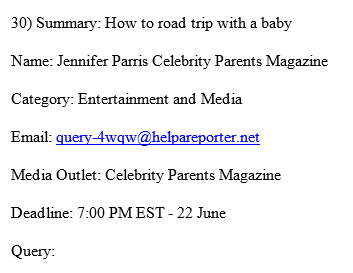
What this means is that the reporter does not know who the hell you are and might not necessarily know why you are emailing them. This is why it is important to give them a clue as to what story you are responding to as this story may not be the only one they have on HARO.
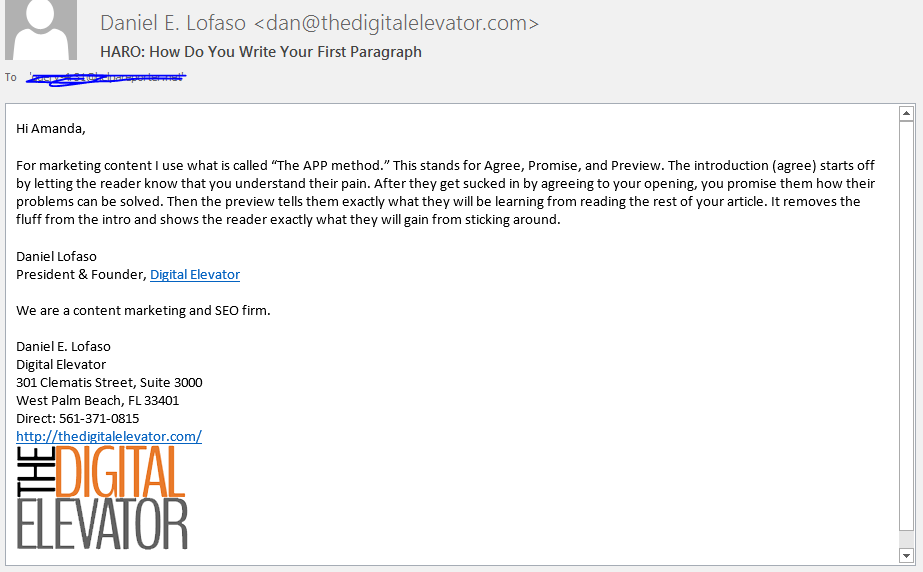
Below is an exact email response I drafted for a PR 4 link that I earned. Take note of the following:
- Title- I titled the email response “HARO: How Do You Write Your First Paragraph” because that was the title of the summary listed on the HARO email. If I used the above summary I would have titled the email “HARO: How to road trip with a baby.”
- Personalization- You’ll notice I start my email with “Hi Amanda” before diving directly into my response. Sometimes the reporter won’t list their name but when they do I always call them by their name. Sometimes I even thank them for their thoughtful consideration to set a nice, polite tone.
- About You- Generally the reporters will be very specific about what they want to include about you in their story. Sometimes they ask for a brief bio (in this case they did not) as well as social media links (in this case they did not). This reporter only asked me to provide my name, title and a link to my website. Still, I provide additional contact info in my email signature like my phone number (I should probably have some social links there too) in the event they want to call me or follow up in some way that they did not mention outright.
Like this tip? Click here to tweet it!
Bonus Tip: Consider the Format of the Stories
When possible, look at other stories your reporter has written (by searching for them on their media outlet) to check their format style. This helps you two ways: one is that it allows you to cater your writing style in a way that meets their approach. Two is that it will give you an idea if you will be featured in isolation or if you will simply be quoted with your expert opinion along with multiple others (most likely).
Tip #4: Write Your Response in MS Word First and Follow These Writing Rules
One of the biggest mistakes you can make with a reporter is sending them something that is littered with grammar errors. This is why I always, always, always write my response in MS Word first so that it spell and grammar checks everything. My Outlook email does this too but not in the same capacity as Word.
After I write the response in Word, I paste it directly into the email (more on attachments below).
It goes without saying that I proofread the crap out of these – 3 to 4 times – before sending them off. If you have a colleague/wife/spouse/seeing eye dog nearby have them read it too and check for edits.
When responding, write in a way that the reporter can cut and paste your content directly into their article. They don’t want to spend their time editing your content (and I don’t mean grammar) so if you place it in a way that they can simply quote you and give attribution you are more likely to get featured.
Tip #5: Consider the Media Outlet to See if the Work Required is Worth Your Time
After I look at topics that I think I want to respond to I also look at the media outlet that is inquiring. Sometimes the reporter won’t place the media outlet in the summary and a lot of times I won’t respond to these queries unless the topic is really appealing and the Query gives some hints that it is actually a pretty big news outlet.
When the media outlet is mentioned, I do a couple of things. The first one is I visit the website (by Googling the name first and finding the .com) and checking its PageRank and trustworthiness (trustworthiness is something that you’ll know just by looking at a website). If the site is less than a PR2 I decide if there is a possibility that the site could become popular or if it has a decent size social media following.
Although my primary goal with HARO is to get links, you can’t forget about the value of exposure even if the site has a low PR.
Thirdly, I look to see if the links on their site are follow or no follow. If you know anything about SEO, you know you want a follow link.
That said, before you invest your time in writing an article and stopping everything you were doing, you have to decide the following:
- Is the link worth it?
- Is the exposure worth it?
- Is the link follow?
If none of these answers is yes, don’t waste your time. If the link is no follow but comes from a huge news source, it will probably be worth your time.
Like this tip? Click here to tweet it!
Tip #6: Reading and Responding to the Question to Make Sure it’s Worth Your Time
It is imperative that you have a full grasp on both the Summary and the Query. Sometimes a Summary will look really enticing coupled with the media outlet but when you read the actual Query – the real meat and potatoes of the reporter’s goal – you’ll find that you don’t want to answer the question or are not suited to.
Sometimes reporters will specify who they want an answer from – be it geographical location, profession, gender or some other limiting factor – and if you don’t fit this bill don’t waste your time responding.
Also, sometimes the Query will differ slightly from what the Summary covers. Point is, read both very carefully and craft your answer in such a way that addresses exactly what they are looking for.
Tip #7: Response Length Should be Around 3 to 4 sentences
Before I started having a lot of luck with HARO links I’d write really long responses. Props to Bryan Conklin from Zylo for bringing my attention to this one.
What I’ve found is that most reporters just want a 2-3 sentence paragraph from you and not a full on blog post.
I think the best rule of thumb is to try to compress your answer to 2-4 sentences and if the reporter wants more leave it up to them to follow up with you.
If you feel that a more substantial piece is needed the benefit is that if it doesn’t get picked up you have yourself a nice blog post or at least the start of one.
If a reporter doesn’t specify response length look for hints in their previous work or stick with the 2-4 sentence rule of thumb as to not waste half your day writing something that may or may not get picked up.
Like this tip? Click here to tweet it!
Tip #8: Don’t Haggle the Reporters to See if They Like Your Submission
Once you send off your finely-tuned email don’t go all nuts trying to get in touch with the reporter to see if you are going to get featured.
For one, the HARO-masked emails won’t work after a certain period of time and if you go all stalker status finding a reporter (they are not that hard to find if they provide their names) don’t haggle them on Twitter.
If they like your response they’ll use it. Don’t be offended if you don’t get any sort of response; these guys and gals are busy, taking things personal won’t help anyone.
Like this tip? Click here to tweet it!
Tip #9: How Reporters Will Typically Respond if at All
In my experience most reporters won’t ever respond to you at all. There will be no “thank you for your submission” email or “we’ll be in touch” Tweet. You’re at their mercy and if you don’t like it don’t use the HARO platform!
If you are not selected it’s because you suck at writing and are but a pawn in your industry. Just kidding! It’s just that reporters don’t respond to tell you that you didn’t make the cut. That’d be an awkward conversation anyway.
If you are selected, here’s what I have usually found to be true based on medium:
- Phone call- you are an industry ninja and you deserve a plaque. This probably also means that the article that is being written requires more details and specifics from those that are featured.
- Email- your reporter probably just needs a little bit more info. I hardly ever get emails with the links to the finished articles I am featured in although I wish I would.
- Social media- most likely Twitter because they can alert multiple contributors at once. They usually just @mention 2-3 people at once and then give a link to the site.
- Skype- your reporter is either overseas, needs some sort of visual of you, or can’t get enough of your good-looking profile picture and needs to have their day made by seeing you in-person.
- Live in person- if you are in the same town as your reporter every so often they might want to meet for coffee. Buy them a cup and keep in touch with them!
Like this tip? Click here to tweet it!
Things that I Think Work to My Advantage in Getting Selected
I probably should have started this post by saying I am no Rand Fishkin, Neil Patel or Brian Dean SEO ninja. I am, however, somewhat known in the industry and my name pops up from time-to-time (sometimes in ways that don’t hurt my feelings).
Here are some reasons why I think I’ve had some pretty decent success with HARO:
- Big Twitter following: While not huge, my 3,600+ followers dwarfs the 200 follower Twitter average. Many reporters don’t even have this many followers so it sort of looks like I’m an authority on something.
- Nice website: I keep the Digital Elevator website up-to-date and modern as well as try to post blogs regularly. This lends to my expertise in both content marketing and SEO.
- Polite & Professional: You want to appear as polite and professional when speaking to reporters. If you are neither you don’t stand a chance.
- I am truly an expert in the topics I respond to: Although I hate to call myself an “expert” at anything, I am very experienced with managing SEO and content marketing strategies and these are predominantly the types of topics I respond to.
Getting HARO Links Recap
By no means is getting HARO links consistently an easy thing and anyone who approaches it should look at it as a numbers game. The more inquiries you respond to the more of a chance you’ll have of getting links. If you can get three links from high quality sources a month then you’ll be getting some decent press and perhaps more attention from potential clients.
Hopefully you learned some good takeaways from the above and you too are on your way to batting 50 percent. Your homework is to implement the above into your next HARO response and to see if you have better luck getting links.
If you have any questions shoot me an email or Tweet and let me know how these strategies worked for you.
Founder and CEO of Digital Elevator. 15+ years of marketing experience helping businesses compete and win online, from emerging startups to Fortune 100 leaders.