// Case study
Frøya Organics
Answer Engine Optimization (AEO) SEO Content Marketing Link Building Digital PR

Frøya Organics is a Norwegian natural skincare and haircare brand built around wild Arctic botanicals. Its formulations use no water, fillers, or preservatives — a genuine product differentiator in a category where most competitors ship 70–90% water. The core audience is women 45+ dealing with mature skin, rosacea, perimenopausal skin changes, and sensitivity, and the brand sells direct-to-consumer worldwide.
Frøya had the two things that usually make a brand easy to cite: a real point of difference and content good enough to deserve citation. What it did not have was the machine-readable infrastructure or the third-party footprint that AI assistants actually use to decide who gets named.
Our AI visibility audit scored the domain 4.5 / 10. The specific failures:
llms.txt. No machine-readable pricing. A Shopify storefront that renders prices in JavaScript, meaning AI agents comparing skincare on a buyer’s behalf simply skipped it.Product markup and nothing else. No FAQPage, no Article with author and dateModified, no Organization with sameAs, no HowTo.The pattern was consistent: the content was good, the extractability was not, and nobody outside the brand was vouching for it in the formats AI reads.
We shipped /llms.txt and a structured pricing file first — the two cheapest fixes with the widest blast radius. llms.txt gave assistants a one-screen summary of what Frøya is, who it’s for, what the hero ingredient does, and which products and reference pages matter. The pricing file exposed the full range and subscription terms as plain text, so an assistant evaluating products on a buyer’s behalf could parse the offer without executing Shopify’s JavaScript.
We layered JSON-LD across the site: FAQPage on every blog post and every brand page, Article with author, author.url, and dateModified on all ingredient and recipe content, HowTo on usage content, and Organization with sameAs to consolidate the brand as a single recognizable entity. That last one mattered more than it sounds — Frøya’s name renders both as “Frøya Organics” and “Froya Organics” depending on the source, and the entity was fragmenting across two spellings.
Four pages published in March intercept the queries an AI assistant fields when someone is deciding whether to trust the brand:
HowTo-marked guidance for existing customers and for assistants fielding application questions.The audit’s most actionable finding was that Frøya’s content was better than the pages being cited above it, and losing anyway because no independent publication had ever named it. AI assistants answering “best natural skincare brand” don’t read your product page; they read listicles.
So we built the listicles. Frøya was placed as a reviewed brand across five editorial roundups in the natural beauty and lifestyle space, targeting the exact query shapes that matter: best natural skincare brands for mature women, best waterless beauty brands, best skincare brands for visible results, best eye care for dark circles. Each placement carried the brand’s differentiator in citeable language and, where the format allowed, a verified clinician quote — a single credentialed voice raises citation probability meaningfully.
We built out the ingredient and recipe content hubs around the botanical topics Frøya actually owns — sea buckthorn, arnica, beeswax, comfrey, borage, rosemary, frankincense, rosehip — each structured as standalone, query-aligned answer blocks with sourced statistics rather than marketing prose. Then we pointed authority at them: 15 niche editorial placements (DR 30–59) to product pages, 63 dofollow homepage placements through a national syndication network, and 14 placements into the blog content itself.
Ten seeded comments across r/Rosacea, r/45PlusSkincare, r/40PlusSkinCare, r/30PlusSkinCare, and r/Skincare_Addiction. The links are nofollow and pass no equity — the value is presence in the subreddits Google surfaces under “Discussions and forums” and that LLMs sample when summarizing real-user sentiment.
We monitor a fixed set of buyer prompts monthly across ChatGPT, Perplexity, Gemini, Copilot, and Google AI Overviews — “best natural skincare for women over 45,” “natural skin tightening products that work,” “Frøya Organics vs other natural skincare brands,” “best affordable natural anti-aging skincare,” and so on — logging who gets cited when Frøya doesn’t. That log is the content roadmap.
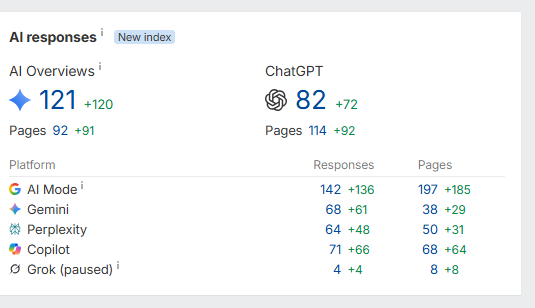
Frøya now appears in 121 Google AI Overviews across 92 pages — a gain of +120 from a starting point of one. ChatGPT cites the brand in 82 responses across 114 pages, up +72.
Across the full assistant landscape the campaign produced 349 AI responses citing Frøya, up +315:
| Platform | Responses | Change | Pages cited |
|---|---|---|---|
| Google AI Mode | 142 | +136 | 197 |
| Copilot | 71 | +66 | 68 |
| Gemini | 68 | +61 | 38 |
| Perplexity | 64 | +48 | 50 |
| Grok | 4 | +4 | 8 |
The brand went from absent in its own ingredient category to being a source assistants reach for.
AI-referred sessions ran at 58% engagement with average session durations of 340–477 seconds — five to eight minutes per visit. ChatGPT sent 89% of that traffic, with Claude.ai, Perplexity, and Gemini splitting the remainder evenly.
The monthly shape tells the real story. January’s daily rate looked strong, but it coincided with the brand’s largest paid social month of the period — a brand-awareness halo, not an organic floor. Measured against the honest February–April baseline, May ran 82% higher, and the elevation began before the Reddit comments were placed. That rules out community seeding and points squarely at the blog link campaign making the ingredient content citeable.
Both spellings of the brand name now account for 96% of all entity-associated organic traffic on the domain, across 147 combined ranking positions — the Organization schema and sameAs work doing exactly what it was meant to do.
| Page | Engagement | Avg. duration | Position |
|---|---|---|---|
| Legitimacy / trust page | 73% | 105s | 3.1 |
| Competitor comparison page | 81% | 92s | 1.7–2.7 |
The legitimacy page ranks in the top three for the brand’s primary navigational query and absorbs the full trust funnel beneath it — reviews, scepticism, and post-purchase intent. The comparison page holds the top two positions across every comparison query in its set and posts the highest engagement rate of any page on the site.
One of the skin-condition posts now surfaces for queries no human types into a search box: “i am looking for a plant based cream for my eczema that actually works” and “what are the most recommended steroid free treatments for chronic eczema in 2026.” That is assistant-shaped demand hitting a page restructured to answer it.
The AEO work did not come at the expense of classic organic performance — it compounded with it. Comparing the pre-campaign period to the campaign window:
| Measure | Change |
|---|---|
| Organic sessions | +162% |
| Organic transactions | +126% |
| Organic revenue | +119% |
| Organic revenue per day | +61% |
| Google organic revenue per day | +69% |
Organic search finished the period as the #2 revenue-generating channel in the business, ahead of both paid search and direct, and converts at roughly 6x the rate of the largest paid social channel.
Homepage average position improved from 14.8 to 8.3 on the strength of the syndicated link campaign, and flagship product pages moved up alongside it, each gaining between one and two and a half positions.
An honest note on attribution: organic growth here is multi-causal. Paid brand campaigns increase branded search volume, which registers as organic. The isolable SEO contributions are the homepage position gain from link building, the blog content beginning to capture non-branded informational queries, and the AI citation growth — which paid spend does not produce.
Frøya’s content was already better than the pages outranking it in AI answers. What it lacked was the infrastructure to be read and the third-party validation to be trusted. Fixing the machine-readable layer, marking up the content for extraction, owning the brand’s own trust queries, and earning a seat in editorial roundups moved the brand from one AI Overview citation to 121 in a single campaign — while organic search climbed to the #2 revenue channel in the business.
Every case study started with a conversation. Tell us about your goals and we will show you what we can do.
Transparent pricing. Scope agreed before we start.