Best AI Content Generator: Bard vs Bing vs ChatGPT vs Jasper

Just how good is AI content from the lens of a professional writer/content marketer?
How does AI content compare to human-written content?
And which AI content generator is the best?
In this blog, I’ll start with a comparison of the most popular players in the AI content world, then get deeper into explaining what AI content means and how it works. I’ll also run each sample through a AI content detection tool to see how human-like the writing is.
Why should you trust me?
Because I’m smart and good looking. Not enough for you? How about because I’m the Content Marketing Director at Digital Elevator and have been a content marketer and writer for the last 15+ years.
Feel free to jump ahead:
- Best AI Content Generators Compared
- Jasper vs Bard vs Bing vs ChatGPT: Which Is Best?
- AI Content Detectors: Testing How Human-Like The AI Content Is
- The Overall Winner
- What Is AI Content Generation And How Does It Work?
- Pros and Cons of AI-Created Content In General
- The Future Of AI Content Generation
Best AI Content Generators Compared
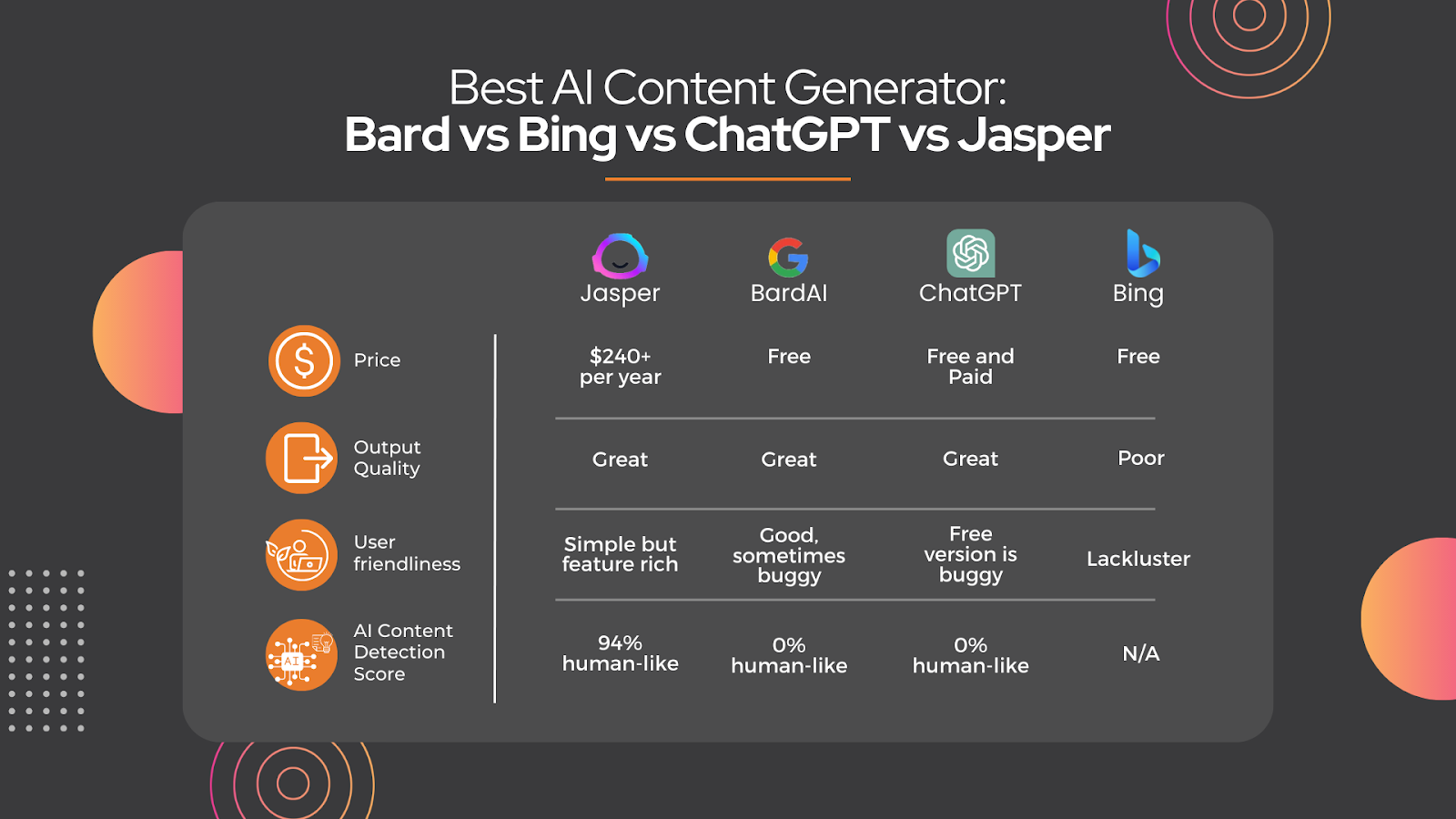
So, what is my experience with the leading AI content generators and which one is best? Let’s dive in.
Jasper vs Bard vs Bing vs ChatGPT: Which Is Best?
I’ve tested all four of these options. Which ended up the best?
I tested many, many prompts, topics and requests on each one for my final opinions and pros and cons. But as a fair test to show you examples of, I asked each service the following prompt, exactly the same way:
“Write a 1000 word blog with the title ‘How To Make Money Online’”. I then pasted the results into a document and I’ve included links to see the exact outputs from each.
Note that I kept all formatting exactly as is - which includes the background after copying/pasting, any headlines, and bullet points exactly as they paste into a document.
So, without further ado, here’s what happened with each, and the pros and cons I gathered from multiple test uses.
Jasper
Jasper, formally known as Jarvis, was actually the first I tested out, as it was up and coming before the others made their big entrances. This means they’ve also had plenty of time to perfect, recently adding in a Chat feature similar to the others.
Jasper does cost money, but there are a ton of features you won’t find on other AI sites, like being able to select what it is you’re doing with a template. Examples of these include blog posts, emails, social media posts, conclusion paragraphs, ecommerce listings, and more.
Here was my test output.
Pros:
- Templates: As previously mentioned, the templates to choose from were plentiful, and I loved being able to tailor it to my needs without having to explain it.
- Formatting: If it gave you an H2 and you copied it into a document, the H2 stays. All formatting copies over, giving you less work.
- Output: Everything seemed to be smoothly written and accurate.
- Surfer SEO Integration: While many AI softwares can write up things it finds scouring the web, Jasper also integrates with SEO engines that can make sure you’re not only writing factually, but you’re writing in a way that helps you rank.
- Built for content creation: The others we tried have different uses. For example, Bing prides itself on being able to answer questions. Like, “where’s the best place near me for a haircut?”, rather than write content on your behalf.
Cons:
- Cost: It has a cost behind it, but with the exhaustive features and productibility, may be worth it for a user, depending on budget and needs.
Bard
Google’s Bard content generator was initially a research project from Google that was aimed to generate original, high-quality poetry. Still in its early stages, it has since transitioned to be used for all types of written creative work.
Bard gives you three drafts to choose from, so here are the three outputs with the test topic here:
When I used Bard to write the sample content piece, here’s what I liked and didn’t like about it:
Pros:
- Great content quality: The paragraphs were not choppy and everything seemed to flow in a human-like way.
- Multiple options: Bard provides you with a few different options for your draft that you can choose between, rather than having to ask again for a different response.
- Speed: Most AI generators use a live-typing display where you essentially watch the AI compose your piece word for word. While it takes a few seconds to pause after your query, Google’s Bard option displays everything immediately on the screen as one finished piece.
- Cost: This one’s free, at the current moment.
Cons:
- Google Rankings: While we can’t say for sure, because Google keeps algorithms and ranking determiners pretty hush-hush, there is always the question in the back of our heads: Will rankings be docked because Google clearly knows you’re using AI content (considering they wrote it)?
- Can be buggy: To be fair, they do say they’re still in an experimental phase, so we can’t weigh this con too heavily. But when first trying to run this test with Bard, I was getting errors like, “Sorry, I’m not programmed to assist with that” - but if I’d try the same exact request a few more times and it would finally give me the output.
- Formatting: Being a Google product, you would expect better formatting with H2s and H3 tags already built into the output for a blog (and that paste well into a Google Document)
ChatGPT
ChatGPT is a state-of-the-art language model developed by OpenAI that uses artificial intelligence to understand and respond to natural language queries. There were a lot of great things about this one.
To see the output of the request, click here.
Pros:
- Versatility: ChatGPT understands a wide range of natural language queries and allows you to select your tone and writing style from a multitude of options, from friendly to clinical, or even sarcastic.
- Learns How You Work: According to OpenAI, ChatGPT is constantly learning and improving based on its interactions with users. The more you use ChatGPT, the better it becomes at understanding your specific needs and interests.
- Prompt Options: I liked that there were different user-created prompts that are already customized to solve a specific problem. If it’s SEO content you want, or just something rewritten, there are many existing prompts to choose from if you don’t want to do your own.
- Great output: The output for this option was very professional and, at first glance, sounded very human-like. There are also limited if any, grammatical errors.
Cons:
- Availability: Unless you pay for the premium service, if ChatGPT is overloaded, you get a screen saying you can’t use it. This brings us to…
- Cost: If you want to be sure you can use the service (and all of the tones, prompts, and conversation styles), you’ll need to pay a premium. Currently, this cost is about $20 per month. It’s also the only way to get access to the newest versions of ChatGPT.
- Pasting Into Documents: When pasting your content into a document, it includes a gray background. If you want to lose the gray background, you have to paste the text unformatted, which means you lose any bullet points, bold wording, and subheadings as well.
Bing
Microsoft’s Bing AI generation is newer to release than the others, which I expected could potentially mean they have a leg up in making theirs bigger and better (spoiler alert: not the case). According to Microsoft, Bing AI shares licensing with OpenAI of GPT software, which you’d think might mean they have similar outputs, but I didn’t find this to be the case.
See the output here.
Pros:
- [Crickets] … I didn’t find a lot of things to praise this one about in comparison to the others. At least not at this stage of the game. Sorry, Microsoft.
Cons:
- The browser: While there is nothing wrong with the Microsoft Edge browser (I’m just being nice, do people actually use it?), they force you to use it in order to take advantage of the browser-based Bing AI generator. They do integrate with things like Skype chat, where you can chat with the AI bot right in your conversations, but unless you prefer to do it this way, it’s not helpful when you have a browser of choice.
- The output: Imagine waking a toddler up from a dead sleep and asking them to explain to you how one might boil an egg. It’s a simple question. But the answer might take 32 left turns before it arrives at anything worthwhile. That’s the output I seemed to get with every question.
- Errors: Not only was the output almost as if they weren’t even “listening” to my question, I often received an error that said, “Sorry, I am out of ideas right now” with a sad face and an error ID code.
AI Content Detectors: Testing How Human-Like The AI Content Is
In addition to the initial tests, I also tested a couple of other random blog topics specifically to see how “human-like” each AI wrote. The blog titles I tested were:
- The Importance of Self-Care: Simple Ways to Prioritize Your Well-Being
- The Benefits of Meditation: How It Can Improve Your Mental Health
- Maximizing Your Savings: Smart Tips for Building Your Wealth
I ran each through a content-checker that analyzes the text and determines how “human-like” it sounds, or if it appears to have come from AI. From the three topics, I averaged the results, and here’s what I found for each:
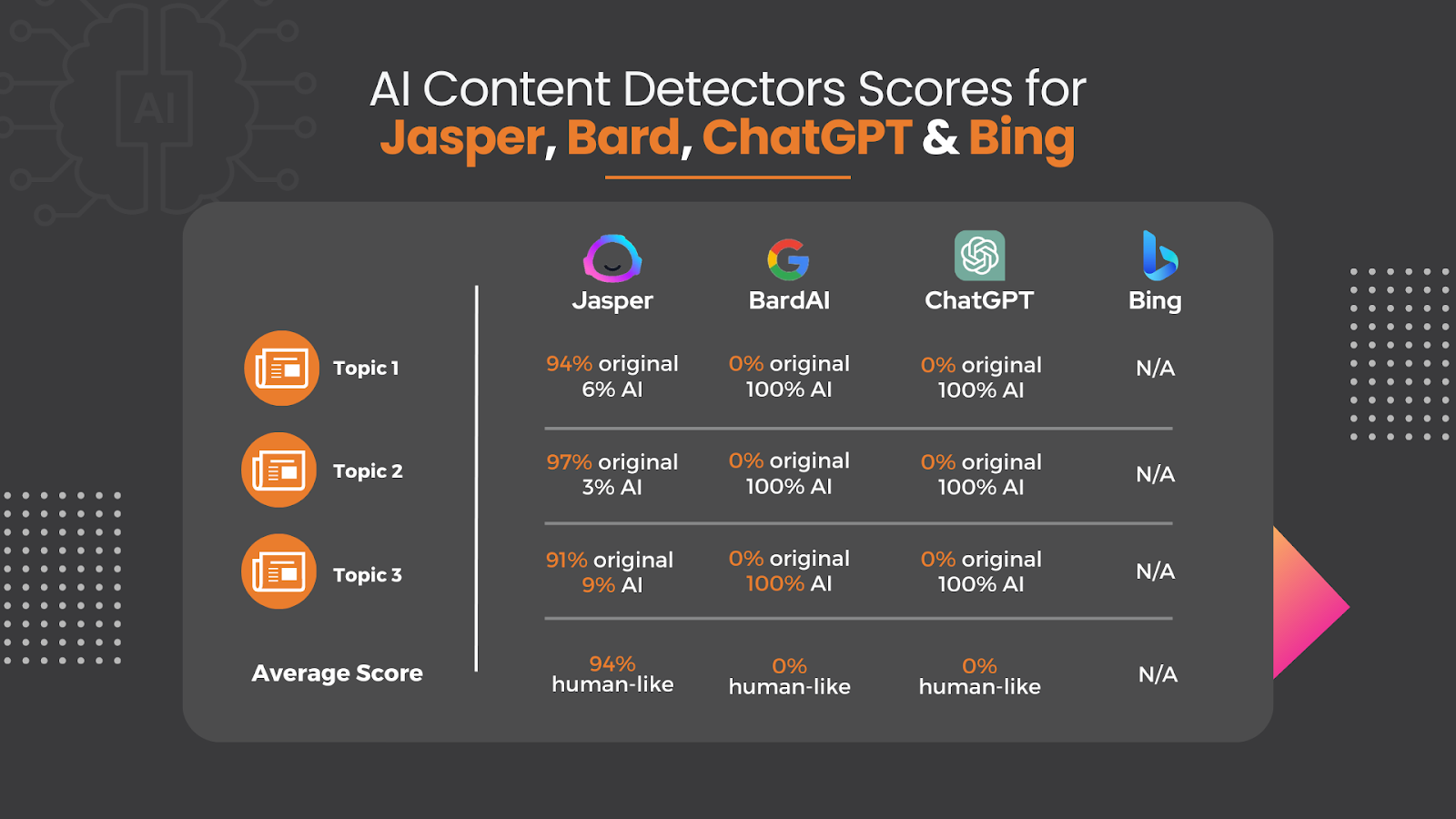
- Jasper
- 1. 94% original / 6% AI
- 2. 97% original / 3% AI
- 3. 91% original / 9% AI
- Average: 94% human-like
- Bard:
- 1. 0% original / 100% AI
- 2. 0% original / 100% AI
- 3. 0% original / 100% AI
- Average: 0% human-like
- ChatGPT:
- 1. 0% original / 100% AI
- 2. 0% original / 100% AI
- 3. 0% original / 100% AI
- Average: 0% human-like
- Bing:
- I wasn’t able to run the content through the detector, as Bing didn’t output actual blogs, but rather answered the question it pulled from the title and sourced where to find information on it.
Keep in mind, each AI content detector could analyze differently, and there are many options out there. But for this test, I chose originality.ai.
Note: Don’t get the originality scores confused with plagiarism - a low originality score does not mean the content is plagiarized - all content tested perfectly for plagiarism from every source - it just means it could be detected as being AI-written by a third party.
The Overall Winner
Jasper seemed to be the most original and unique content that didn’t get detected as being AI.
Besides the AI detection scores, ChatGPT is up there on my ranks for being quality content, and Bard is third. While the outputs appeared pretty on the outside, both ChatGPT and Bard’s results of the originality test were a huge turn-off - and a shock - especially since Bard is Google, and who hates unoriginality more than Google does?
Jasper had excellent outputs that sound very human-like and professional. I didn’t find any of them to give any inaccurate information, either.
Both of my top two picks (Jasper and ChatGPT) were also great at creating outlines for topics - so even if you don’t want to use AI to create the actual piece, they can provide an outline that steers you in the right direction and sparks some creativity.
That all being said, when it comes to writing actual blogs, not one of the four paid attention to word count. For example, if I said, “write a 1500 word blog on bumble bees”, it might give me back 400-800 words. So no matter which you choose to go with, I found it to be most beneficial when asking specific questions to generate responses to or to elaborate on subtopics I already knew I wanted.
If I were to choose just one to continue to use, it would be Jasper, with ChatGPT coming in a close second. Both come with a premium that seems well worth it for the increased functionality, content quality, reliability, and features. You get what you pay for, right?
What Is AI Content Generation And How Does It Work?
AI-generated content refers to any text, image, video, or audio content that has been created either entirely or partially by artificial intelligence algorithms. Yes, we’ve finally made it there.
These algorithms use natural language processing (NLP) techniques to understand and generate human-like language, allowing them to produce a wide range of content, such as news articles, blog posts, product descriptions, and social media updates.
AI-generated content can be created in different ways. One method involves providing the AI software with a specific topic or keyword and then allowing it to generate a complete piece of content based on its understanding of the topic and relevant data sources. Another approach involves using AI to assist human writers by suggesting ideas, phrasing, or correcting grammar errors in their writing.
Where Does AI Get Its Information?
AI content generators have a range of sources from which they can gather information. Some rely on structured data sources like databases, news feeds, or social media platforms, while others use machine learning to analyze unstructured data like text documents. The sources used can depend on the type of content being generated and the specific algorithm being used.
For example, if an AI content generator is creating a news article, it might gather information from reputable news outlets or wire services. If it’s generating product descriptions, it could use data feeds from e-commerce sites or product catalogs. Some AI content generators may even take inspiration from pre-existing content, using it as a starting point to generate something new and original (which is something we, as marketers and content creators, need to be cognizant of - I will get to that later in this blog)
Of course, as with any content creation process, the quality of the information used can have a significant impact on the quality of the output. That’s why it’s important to carefully evaluate the sources used by AI content generators to ensure that the information is accurate, reliable, and relevant.
Pros and Cons of AI-Created Content In General
AI-generated content has its advantages and disadvantages. Here are some of the pros and cons to consider:
Pros:
- Efficiency: AI-generated content can be created quickly and efficiently, allowing businesses and individuals to create a large amount of content in a short amount of time.
- Consistency: AI algorithms can ensure that the tone and style of the content remain consistent across a large volume of output, which can help to establish a brand or voice.
- Cost-effective: By automating the content creation process, AI-generated content can save businesses and individuals money on content creation costs.
- Scalability: With the ability to generate content at a rapid pace, AI-generated content can scale to meet the needs of even the largest content marketing campaigns.
Cons:
- Lack of Creativity: AI-generated content may lack the creativity and personal touch that human writers can bring to their work, which can result in content that feels generic or bland.
- Limited Understanding: AI algorithms may struggle to understand complex or nuanced topics, leading to inaccuracies or errors in the content produced.
- Quality Concerns: Without proper oversight, AI-generated content may contain errors or inaccuracies that can harm a business’s reputation or credibility.
- Ethical Concerns: There are ethical concerns surrounding the use of AI-generated content, particularly in cases where it is used to generate fake news or misleading information.
- Search Engine Rankings: Because its so new, we have yet to see the longer term impact using AI-content might have on search rankings. To put it into perspective - if AI is writing your content, other AI (like Google spiders) could soon be able to tell what came from AI, and the consequence of that is a future mystery.
Overall, AI-generated content can be a valuable tool for businesses and individuals looking to create a large amount of content quickly and efficiently. However, it should be used as just that. A complement to your human-written work, not a replacement for it.
What do marketers think of AI-written vs Human-written content?
According to fresh data from a recent industry survey, 65.8% of people believe AI content to be equal to or better than human-written content.
The Future Of AI Content Generation
The future of AI-generated content is exciting and full of possibilities! As AI algorithms continue to evolve and improve, we can expect to see even more advanced and sophisticated forms of content generation.
One of the key areas of development is natural language processing, which will allow AI algorithms to understand and interpret language in a more accurate way. This will enable them to generate content that is more creative, engaging, and personalized to the needs of individual users.
Another area of growth is in the use of AI-generated content for immersive experiences, such as virtual reality and augmented reality. AI algorithms can help to create rich and interactive content that responds to user input and adapts to changing environments, creating a truly immersive and personalized experience.
There are also exciting opportunities for AI-generated content in the field of education and training, where it can be used to create interactive and engaging learning materials that adapt to the needs of individual learners.
Of course, as with any technology, there are also potential risks and challenges associated with AI-generated content. It will be important to ensure that AI-generated content is used responsibly and ethically and that proper oversight and quality control measures are in place to ensure accuracy and reliability.
Overall, the future of AI-generated content is full of potential, and we can expect to see even more innovative and exciting developments in the years to come that can help assist with your content creation.
Founder and CEO of Digital Elevator. 15+ years of marketing experience helping businesses compete and win online, from emerging startups to Fortune 100 leaders.