

Biotech SEO is most successful when fundamental SEO – on-page, site architecture, technical – is done correctly, given the relative niche of most products and services. Most biotechs get this wrong, presenting an opportunity for SEO-driven efforts to enjoy increased market share. Couple foundational SEO with link building and digital PR, and you have a recipe for success.
If you are trying to rank your biotech website and earn free search engine traffic, the focus areas of your SEO campaign can admittedly be difficult to triage.
This guide will outline an SEO strategy tailored for biotech companies, encompassing key aspects such as on-page optimization, SEO-driven content marketing, and off-page SEO techniques.
These are many of the strategies we use at our biotech SEO agency to help rank sites in competitive verticals that need to capitalize on gaining market share.
On-Page SEO is the Foundational Work Driven by Keyword Research
In biotech SEO, the range of niche products and services is vast, meaning smaller brands with superior SEO can often compete on the big stage. This also relates to keyword difficulty (KD) scores of important keywords being considerably lower than most industries, often presenting an opportunity to rank quickly when fundamental SEO is put in place. The primary fundamental factor being on-page SEO.
On-page SEO refers to the optimization of your website’s content and structure. This includes things like the implementation of keyword research, title tags, meta descriptions, site speed and internal linking.
Each of these subtopics deserves guides of their own, so rather than trying to drill down into each area, I’ll provide my most actionable recommendations.
Keyword research
At the end of the day, people are still typing words into search engines and looking for applicable results. The key terms there being “applicable,” or contextually relevant results.
Google ultimately decides what the intent is of each search, so any good keyword research involves an understanding of the intent of a search as well as:
- Keyword volume
- Keyword difficulty
When selecting the keywords you want to target for your biotech, it is important to implement them according to the appropriate sections of your site. For example:
Transactional intent keywords
These are for users who want to buy something now. I’d recommend these for your product or service pages specifically.
For example, a search for “research lab management software” is highly transactional in intent and is representative of a searcher looking to buy software. As shown in the example below, this is an opportunity to target a service page (or in this example, the homepage) of your site to the search.

On the other hand, another intent might be centered around seeking information.
Informational intent keywords
For example, a how to search like the below is more informational and is better-suited as a blog or resource rather than a service page.

When creating a new SEO campaign, we always prioritize the “money-making pages” over the informational-type pages. Commercial intent keywords, and therefore pages, are considered bottom of the funnel and where you want to focus your keyword research and content efforts before trying to drive more traffic with informational intent searches.
While a user might land on your site from an informational search, it’s the money-making product or service pages that convert them into customers.
Other areas to focus on for on-page SEO include:
1. Title Tags and Meta Descriptions:
Title tags and meta descriptions are the snippets of text that appear in the search engine results pages (SERPs). They are an important factor in determining whether or not people will click on your website.
Title tags should be no more than 60 characters long and should include your target keyword. Meta descriptions should be no more than 160 characters long and should provide a brief overview of your website’s content.
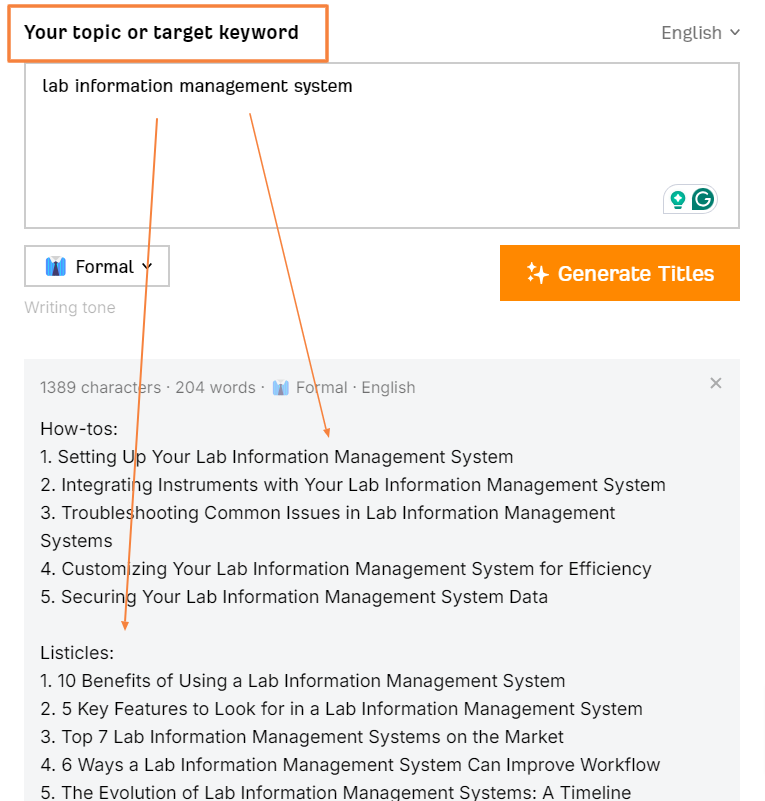
Ahrefs has a cool title tag and meta description generators you can use to get results like this:
2. Header Tags:
Header tags are used to structure your website’s content and to indicate the hierarchy of information on each page. Search engines use header tags to understand the main points of your website’s content and to rank your website for relevant keywords.
Use h1 tags for the main title of your page, h2 tags for subheadings, and h3 tags for sub-subheadings, infusing relevant keywords into each to try to rank for as many keywords as possible.
3. Image Alt Text:
Image alt text is the text that appears in place of an image if it cannot be displayed for some reason. It is also used by search engines to index your images and to understand the content of your website.
Image alt text should be descriptive and should include your target keyword. To save time, check out this AI image alt text generator.
4. Website Speed:
Website speed is a critical factor in SEO. If your website takes too long to load, people will abandon it and you will lose traffic. It is also a ranking signal.
There are a number of things you can do to improve your website speed, such as optimizing your images, using a content delivery network (CDN), and minifying your code. Use a tool like GTmetrix to analyze pagespeed and get actionable insights.
Site speed improvement, in general, is usually a task best suited for development teams in conjunction with server or hosting experts.
5. User Experience:
User experience (UX) is another important factor in SEO. If your website is difficult to use, people will not want to spend time on it.
Make sure your website is easy to navigate and that your content is easily readable. You should also make sure that your website is mobile-friendly, as more and more people are accessing the internet from their smartphones and tablets.
For example, the below homepage is an example of poor UX. It is not immediately clear what action a user should take when they land on the page, what buttons to press, what menu options to click, or how the site can help me. This design, in all likelihood, would result in decreased leads.

Links & Domain Rating: Understanding the Landscape
Before embarking on any SEO campaign, it is important to conduct a thorough SEO competitor analysis to gain insights into the strategies employed by your rivals. This involves identifying your top competitors’ rankings, analyzing their website structure and content, and evaluating their backlink profiles.
For example, check out the below example of a search engine results page (SERP) pulled from SEO software Ahrefs. The top five sites for the search “cloud lab as a service” provide us with a few important qualitative and quantitative link metrics that give an understanding of the competition:
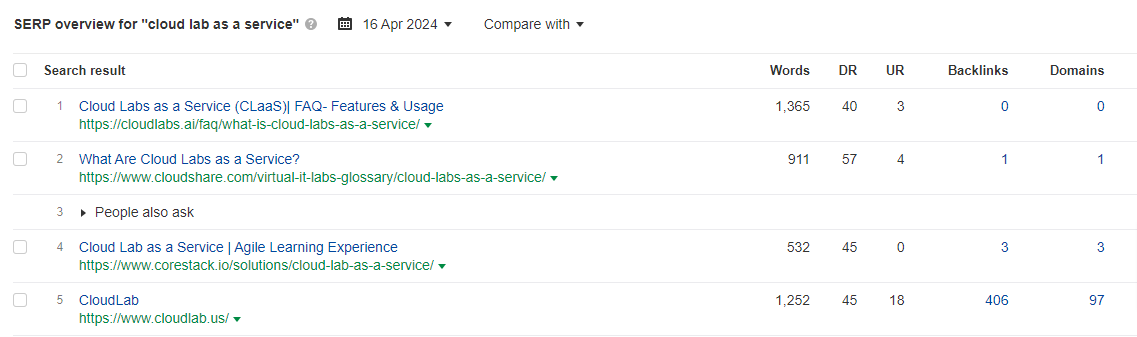
The DR and Domains columns indicate the domain rating and the amount of referring domains the URL has, respectively. The higher the DR, the more difficult it might be to rank for the keyword. In this case, the highest DR on this search is a DR57.
The referring domains range from 0 to 97, but the 97 referring domains are for the result that showcases a homepage, so that naturally would have more links.
If my site were relatively close in DR (say, 35-55), good on-page coupled with three backlinks would likely secure my spot in the top three.
Site Architecture Driven by Keyword Research & Logic
Site architecture updates are usually a quick win that we implement after conducting keyword research. These are most impactful when implemented into the top menu as well as drop-down menu’s as indicated in this example.

Standalone product pages that may be revealed by keyword research can be implemented into top menus and mega-menus to help place emphasis on these pages from a crawling standpoint and from an user experience standpoint.
This is an opportunity to build upon internal links and, when necessary, create static product and service page content that will help drive bottom of the funnel visits for commercial intent keywords.
But don’t stop with static pages in your drop downs, linking to your best resources is also a great way to increase exposure and provide added weight to your internal links for things like blogs or guides like in this Halo Labs example.

SEO-driven Content Marketing for Biotech
The topics you cover as part of your SEO strategy matter and should be planned strategically. This where SEO and content marketing overlap, although we recommend SEO-driven content marketing for our biotech clients.
For example, considering business impact alongside your content marketing efforts is important to help with lead generation or monetization. For example, check out this asset from ThermoFisher on Useful Numbers for Cell Culture.

This SEO-driven resource ranks for over 3,000 keywords, has earned 46 links, and has an equivalent value of $7,400 per month if the same traffic was generated via Google Ads.
When to Utilize Digital PR for SEO Gains
Modern day SEO recommends the organic, as opposed to forced, building of links and brand mentions. The best way to do this is via digital public relations (PR).
For biotechs that are trying to get in front of partners, investors, or pharmaceutical executives, getting exposure in major media outlets is good for business and for SEO. When you get featured on media outlets, they will often mention your brand or link to your website, both of which are search engine signals that can help to rank your website.
For new brands, this is often an ideal starting point for off-page SEO, as it builds trust signals with search engines that will help reinforce additional SEO efforts. When goals are related to brand awareness, we usually recommend digital PR strategies to help clients get featured in industry publications and to build the associated backlink profile.
Keep in mind, ranking individual pages for target keywords involves a bit of a different link building strategy, and that is where many life science companies leverage Biotech SEO agencies. Where digital PR often generates brand mentions or links to the homepage, ranking individual URLs is an entirely different endeavor.
Should I Go In-house or Use an Agency for SEO?
The decision of whether to handle your SEO in-house or hire an agency is a complex one. There are a number of factors to consider, such as your budget, your in-house expertise, and your desired level of control.
If you have a large budget and a team of experienced SEO professionals, you may be able to handle your SEO in-house. However, if you have a limited budget or in-house expertise, you may want to consider hiring an agency.
A biotech SEO agency can provide you with several benefits, such as access to expert SEO professionals, access to specialized tools and resources, and a proven track record of success.
There are additional considerations for SEO and launching campaigns as well.
There can be an opportunity cost in not working with a marketing agency.
The time it takes to get something to market matters.
If a marketing agency can take something to market in half the time it takes an in-house team, consider the impact that can have on your business.
Those potentially untapped leads will be further along your sales cycle, and the ROI from investing in marketing with an agency will have a significant business impact compared to trying to save money using an in-house team that has a different focus.
As you plan ahead or are getting SEO budgets together, consider the opportunity cost of not launching marketing campaigns quickly and effectively.
Get a free SEO strategy from our team today.
The discovery call is the first step in discussing your business, your goals, and the potential services you need for your marketing or web design campaign.


